
Audrey is Alfred's sweetheart and wife, whose life with him provides the emotional centre of Forever Ago. The opening lets you experience her curiosity directly through photography. Later memories reveal affection, disagreement, and the painful period of her illness, while the journal she prepared gives Alfred a reason to travel after her death.
This page contains relationship and late-story spoilers. It focuses on Audrey's character and place in the story rather than listing every petal discovery or providing the final chapter's full route. Her importance comes from the shared life the game depicts, not simply from being the loss that starts Alfred's journey.
The opening gives Audrey an active point of view
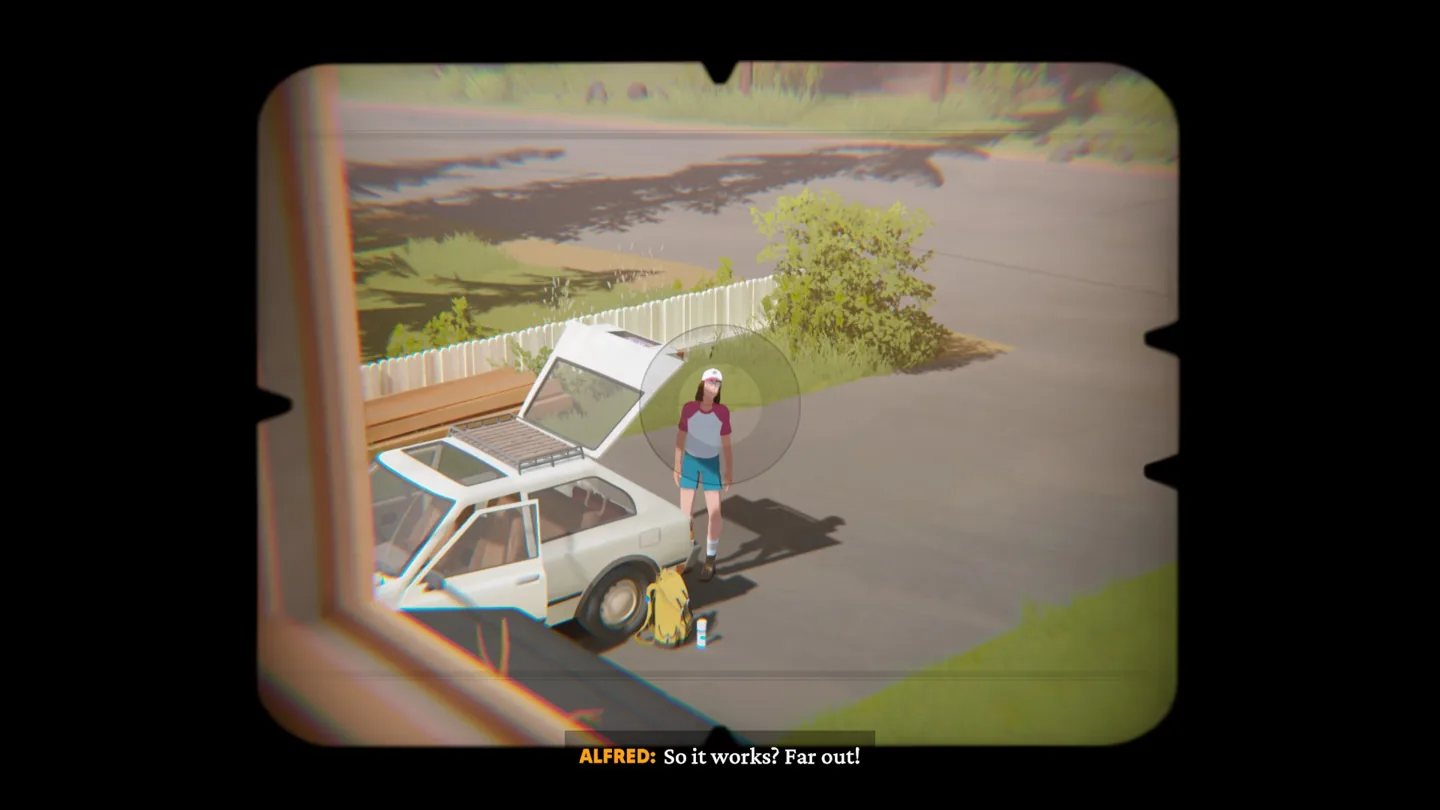
Forever Ago introduces Audrey through a camera-led sequence. You see details of a room, photograph objects, and hear her observations before Alfred becomes the main character of the later journey. This gives her curiosity a form you participate in rather than only hear about afterward.
The camera creates a natural reason for her to notice small things. A teddy, wall pictures, a calendar, and Alfred outside the window become subjects. Those observations establish a relationship through ordinary details instead of beginning with a summary of how much the couple loved each other.
Alfred's poses and their conversation make the exchange playful. Audrey is not only preserving scenery; she is looking at a person she cares about. The difference matters because photography later becomes Alfred's tool for returning to a life she once helped him notice.
The opening also acts as the tutorial. Learning to take pictures is therefore tied to learning Audrey's way of paying attention. The mechanic and character introduction reinforce each other: the player begins the journey by looking outward with her.
The early trip establishes their different temperaments
Audrey comes across as outgoing and adventurous. Alfred can be both confident about his intentions and uncertain about how to carry them out. Their exchanges give the relationship movement because they do not always approach the same situation in exactly the same way.
The camera eventually passes from Audrey to Alfred, and the opening shifts into third-person movement as he follows her along the trail. That change gives you another view of the couple. After seeing Alfred through Audrey's curiosity, you see Audrey as the person beside whom he is travelling.
The outdoor scene combines photographs, conversation, and shared movement. None of those actions needs to be grand to establish affection. Their importance comes from how the two respond to each other while doing something ordinary together.
This helps explain the later game's reliance on small memories. A roadside stop, a flower, or a view can matter because the relationship was lived through such things. The story does not need every recalled moment to be a major milestone in order for it to reveal who Audrey was.
Audrey's optimism changes the proposal memory
One remembered part of the relationship centres on Alfred's intention to propose. He wants the moment to follow a carefully prepared plan, but a series of events disrupts it. Audrey's optimism helps him find the courage to express what matters despite the imperfect circumstances.
The scene develops both characters. Alfred's plan reveals how much the moment means to him, while his uncertainty makes the failure of the arrangement significant. Audrey responds in a way that keeps their relationship larger than the details he hoped to control.
The lesson is not that preparation or a meaningful place has no value. The couple's shared locations matter throughout the game. What changes is the idea that a moment is ruined simply because life does not reproduce the arrangement one person expected.
That idea later becomes much harder for Alfred to accept. A disrupted proposal can become a warm memory; illness and loss cannot be resolved by the same easy optimism. The earlier scene gives the couple's recurring attitude toward plans a personal history before the story tests it more painfully.

The memories show a shared life rather than a perfect image
Audrey and Alfred's relationship includes disagreements and difficult moments. The game presents affection without suggesting that love prevents conflict or makes each person respond ideally. This is important to Audrey's story because it gives her a place within a lived relationship, not a flawless portrait assembled after her death.
The optional vignettes reveal smaller moments from the couple's past. Finding them gives additional context for how they spent time together and how a present-day place connects with an earlier one. Those scenes expand Audrey beyond the major events that drive the plot.
Main-story memories serve another purpose. Some are darker and relate to the painful final period Alfred carries with him. The difference between optional warmth and required distress helps show why remembering Audrey can bring both comfort and regret.
Do not collapse the different scenes into a single version of her. The curious woman in the opening, the partner in a proposal memory, and the person facing illness belong to the same lifetime. The emotional force comes from recognising that continuity across changing circumstances.
Illness changes what the couple can plan together
Later memories show Audrey facing serious health difficulties. Alfred is desperate to help her and hopes that action can improve the situation. The story shows the strain when her strength and energy are no longer enough for the trip they attempt.
This is where the earlier theme of planning becomes painful. Alfred can arrange a journey or try to help, but he cannot ensure the result he wants. His care and his frustration can exist together, and the later road trip reveals the guilt and regret he carries from that period.
The available story evidence supports Audrey's illness and the impact of her final years. It does not justify adding a diagnosis, treatment schedule, or precise medical timeline merely to make the account sound more complete. Her role in the narrative can be explained without inventing those details.
Audrey's declining strength also changes the scale of their shared life. A task or conversation within a room can matter as much as travel. The later memory of Alfred bringing her soup makes that shift tangible through an ordinary act of care.
The journal extends Audrey's care into Alfred's future
Audrey planned the route Alfred follows after her death. Its tasks direct him toward places associated with their relationship, but the intention is not only to make him repeat old movements. The trip encourages him to leave home, engage with the world, and encounter life beyond private grief.
The journal provides a structure he can follow when his own motivation is uncertain. A destination and a small task can be easier to act on than an abstract instruction to recover. The practical list turns Audrey's care into something Alfred can do one step at a time.
At the same time, the places have changed. Familiar people may be absent, an old business may operate differently, and an expected stop can become difficult. The route therefore asks Alfred to respond to the present as well as remember the past.
That balance gives Audrey's plan depth. She connects him with their shared life while leaving room for experiences she could not personally provide. Alfred meets new people, accepts help, and travels with a dog, so the journey becomes more than a perfectly preserved version of the couple's earlier trips.
Photographs keep Audrey's perspective present
The instant camera links the opening with Alfred's later travel. Audrey first introduces attention through photography; Alfred then uses the same kind of action to preserve his own moments. The tool carries continuity without making his later pictures copies of hers.
Selecting images for the journal gives Alfred a chance to record the present beside older associations. The page can contain a view he came to remember, but also a companion or person who mattered during the new visit. The shared practice of taking pictures becomes capable of holding change.
Optional memory photography works differently but supports the same connection. Petals reveal fragments of the couple, and photographing the resulting scene makes a smaller part of their past available. These discoveries show Audrey within moments that the main itinerary does not always stop to explain.
Neither use of the camera can restore the relationship unchanged. A photograph preserves a moment; it does not make that moment happen again. That distinction fits Audrey's role in the trip: she remains present through memory and intention while Alfred has to live in a changed world.

The final note connects remembrance with continuing life
Near the story's conclusion, Alfred returns through memory to Audrey and then reads her final note in the journal. The placement connects the painful final period with the care behind the route he has followed. The written record comes from a person whose relationship with him included much more than that final difficulty.
The note also helps reframe Alfred's tasks. Revisiting a destination is valuable, but the trip's effect depends on what he does while there: noticing, talking, helping, and allowing other people to matter. He cannot fulfil its deeper intention by remaining completely closed to the world around him.
This is an interpretation of the story's movement, not a claim that Audrey left a hidden gameplay condition tied to one exact photograph. The journal has both practical and emotional roles. The game can complete its route while leaving the player to think about what those actions meant.
The epilogue presents Alfred at home with the dog and ordinary activities. It does not erase Audrey or replace their marriage. It gives the memories a continuing context within a life that can still contain care, attention, and companionship.
Read Audrey's story through what she does
| Part of the story | Audrey's presence | What it adds to the relationship |
|---|---|---|
| Opening photography | Curiosity and direct observation | An active perspective before the later loss |
| Shared outdoor travel | Conversation and affection | The couple's everyday closeness |
| Proposal memory | Optimism when a plan goes wrong | A response to Alfred's uncertainty |
| Smaller vignettes | Additional shared moments | A lifetime beyond its major milestones |
| Illness memories | Changing strength and difficult circumstances | The limits of control and the reality of care |
| Journal and final note | A plan for Alfred after her death | Concern for his continuing life |
The most useful way to understand Audrey is to connect those parts rather than reduce her to the reason Alfred is sad. The opening gives her a voice and perspective. The memories reveal the relationship's warmth and complexity. The journal shows her care reaching toward a future she cannot share in person.
Alfred's journey then develops around that continuing influence. He takes photographs, faces changed places, and makes new connections while remembering the person who taught him to notice the world with her. Audrey's story remains part of his life without requiring that life to stop at the moment of her loss.