
Forever Ago is best suited to players who want a short, deliberate story about love and bereavement, with exploration and photography giving that story a physical shape. Its main appeal is the relationship between Alfred and Audrey. Its main limitation is equally clear: walking, looking, talking, and completing small tasks occupy much more of the journey than demanding puzzles or mechanically varied challenges.
That balance matters more than the attractive scenery. If slow movement lets you settle into a place and listen to its characters, the structure has a clear purpose. If you need frequent decisions, escalating challenge, or systems to master, the same structure can feel restrictive. This review keeps the final revelations unspoiled while explaining the experience you would actually be choosing.
The relationship is the reason to keep travelling
The game follows Alfred, an elderly man driving north in a camper van after a tragic loss. His route revisits places that mattered to him and Audrey, and his journal connects practical tasks with their shared past. The destinations are therefore more than attractive roadside stops. A building, flower, photograph, or familiar view can reveal why he came and why returning is difficult.
The opening gives Audrey a presence of her own before the later journey settles around Alfred. Photography introduces their curiosity and affection through small observations. That makes the transition to the older Alfred effective: you have a concrete sense of the people who shared these places, rather than simply receiving a description of a happy relationship after it has ended.
Alfred is often impatient and withdrawn. His behaviour can make early encounters uncomfortable, particularly when the people or businesses he remembers have changed. The contrast with his younger self gives this roughness context without making every rude response appealing. You are spending time with a character whose relationship with the world needs to change, and some of that time involves watching him resist help or conversation.
The strongest narrative idea is the movement between ordinary memories and painful ones. Warm scenes explain what has been lost; darker sequences complicate how Alfred remembers it. The game also allows disagreement and regret into the relationship. That prevents the central couple from functioning only as a sentimental ideal, even though affection remains the foundation of their story.

Photography turns recollection into an action
The instant camera is central to the experience. You use it for prompted scenes, record parts of the road trip, and photograph memories revealed during exploration. Those uses give the same tool different emotional roles. A picture can be an objective, a discovery, or your choice about what Alfred should carry forward.
At later journal moments, you choose up to four photographs to keep. That selection creates a small pause between destinations. Instead of treating each location as a completed level that disappears behind you, the album asks you to decide what deserves a place in the record. Faces, landmarks, and incidental details can all tell different versions of the same stop.
The camera is not a deep photography simulation. Its value comes from context rather than an extensive technical system. Selfies and facial expressions provide lighter moments, while the return to a familiar view can support a much heavier one. The action of taking a photograph remains simple enough that the story can stay in the foreground.
Optional memory vignettes add another layer. Flower petals lead to fragments of Alfred and Audrey's past, and photography helps reveal those moments. They encourage you to look around compact environments rather than walk directly through the required task list. Their reward is additional relationship context, which suits a game built around attention and recollection.
That also establishes a limit. If finding a memory is only worthwhile to you when it grants an ability, improves equipment, or changes a combat strategy, these discoveries may feel slight. Here the meaningful reward is what you learn about the couple and how the present place compares with the remembered one.
The small tasks work when their context matters
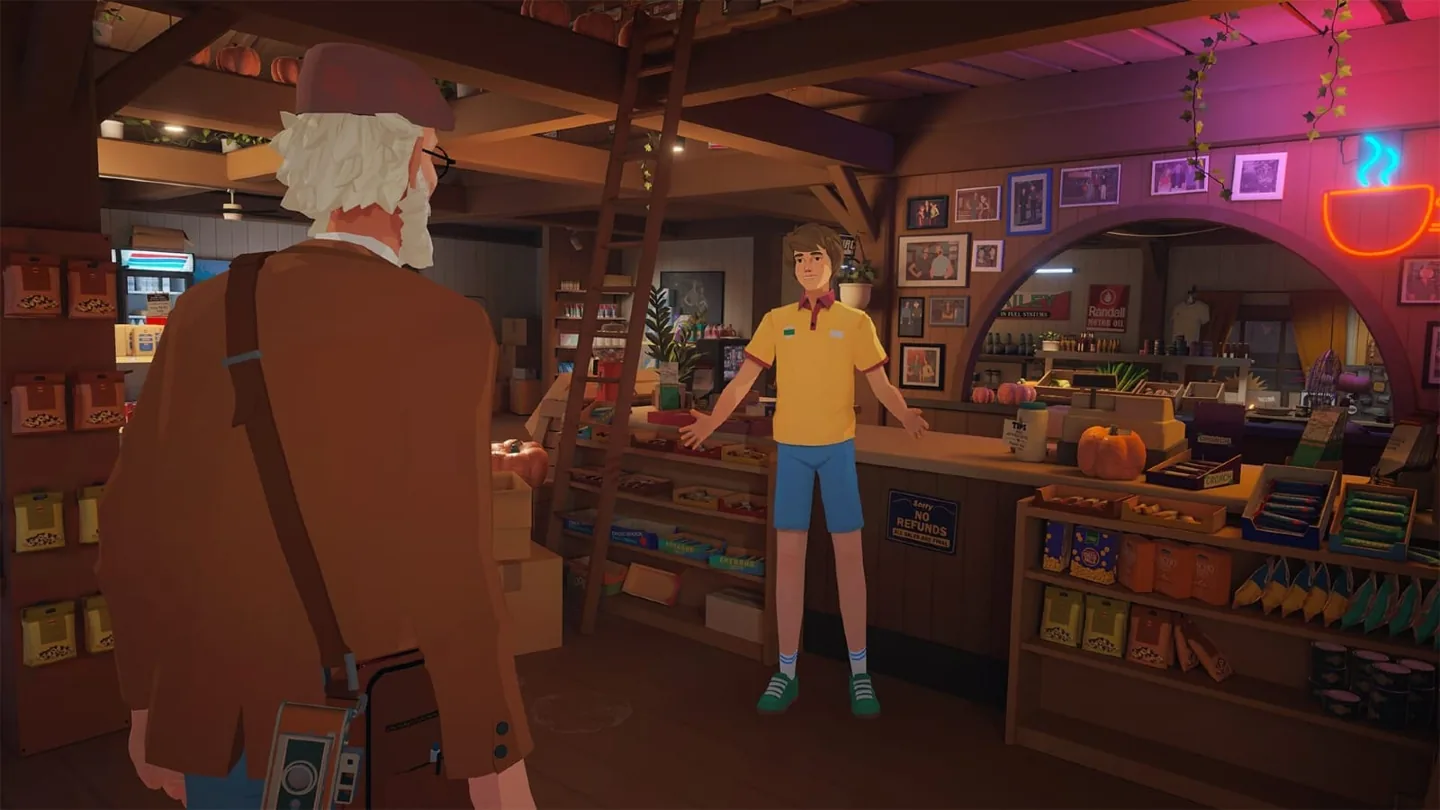
Most interaction consists of walking around a destination, examining objects, speaking with people, and completing a short set of objectives. A roadside shop provides supplies and a conversation. A diner combines personal associations with practical obstacles. Later stops introduce other small environmental actions, but the journey stays focused on Alfred's experience.
The journal provides direction, so you usually have an understandable reason to be in an area. That helps distinguish quiet exploration from wandering without a goal. The tasks also make Alfred participate in the world around him: he cannot remain entirely inside his memories while other people need something from him or offer assistance.
The trade-off is that practical errands can delay the emotional material you came to see. An action may be narratively appropriate and still feel mechanically routine. Forever Ago asks you to accept that collecting an item, finding an interaction prompt, or walking to the next conversation is part of its pace, rather than a challenge whose design becomes increasingly complex.
Its dialogue also does not offer the main attraction of a broad branching narrative. You can participate in conversations and make smaller choices, but the road trip has a strongly authored direction. Approach it for the development of its characters rather than for a promise that every response builds a different version of the ending.
Slow traversal is a central preference test
The deliberate speed is not confined to the opening. Alfred's movement, dialogue, and some traversals ask you to spend time inside the scene. That can make the environments feel inhabited and give a conversation space to land. It can also turn a clear destination into a longer walk than an impatient player wants.
A short runtime does not automatically mean a brisk game. The story can fit into an evening while individual passages remain slow. This is why the question is less about whether you can finish it quickly and more about whether you enjoy how it spends those hours.
The compact destinations reduce the scale of exploration, but they do not remove the need to inspect surroundings. Looking at details supports the story and helps you find optional memories. If you repeatedly follow only the next compulsory prompt, you can reach later scenes with less of the context that makes the journey distinctive.
For a first session, let the opening establish the rhythm before deciding to collect everything. Listen, take a few deliberate photographs, and notice whether the small environmental details interest you. That is a more useful test of suitability than expecting the game to reveal an action-heavy second identity after its quieter introduction.
Presentation supports the changes in mood
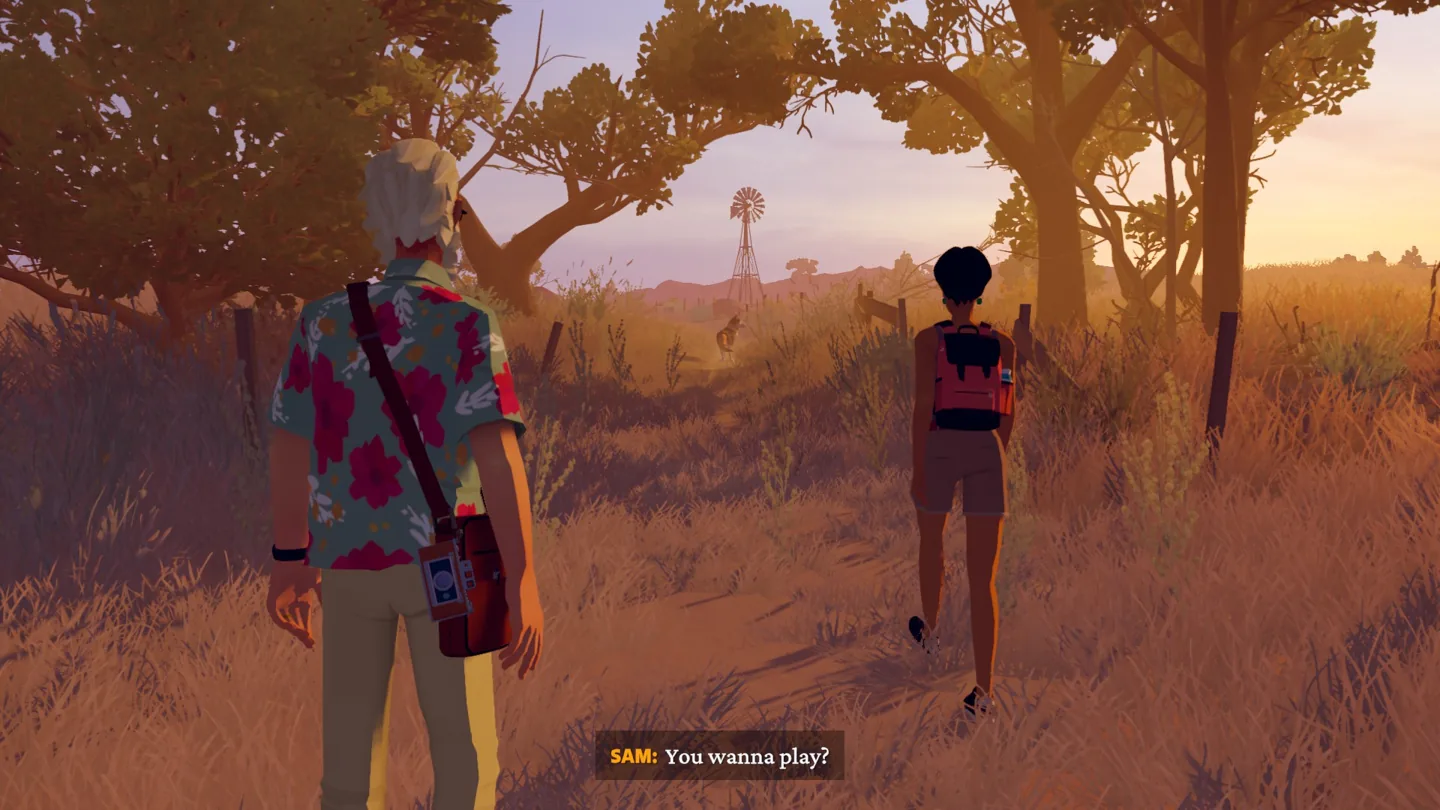
The environments use a colourful, painterly style. Forest trails, roadside interiors, open desert, and other stops give the journey visual variety while remaining part of the same world. The contrast between brighter memories and more troubled sequences helps communicate a change in Alfred's experience without relying on dialogue alone.
Character performances carry much of the relationship. Piotr Michael voices Alfred and Cissy Jones voices Audrey, and the spoken exchanges give small interactions emotional context. The game often needs a line to communicate affection, fatigue, impatience, or uncertainty without turning it into a long explanation.
Clark Aboud's soundtrack provides another part of that rhythm. The score supports both warmth and melancholy, matching a journey whose mood does not remain uniformly comforting. For players drawn to this kind of story, listening is as important as looking at the scenery.
That is also why the attractive art should not be mistaken for a promise of constant relaxation. The subject includes illness, grief, regret, and loss. Quiet surroundings and a dog companion soften parts of the trip, but the story deliberately moves into difficult memories. Choose a time when you want that emotional material, rather than treating the setting alone as a guide to its tone.
Technical friction can interrupt the quiet rhythm
Interaction detection is a practical weakness to keep in mind. Some objects can require a more precise view than their position initially suggests, so standing in front of a door or another usable object may not immediately produce the expected prompt. Adjusting your viewpoint can become an interruption in a game that otherwise asks for patience and immersion.
Performance experiences are not uniform. Launch impressions include occasional stuttering and frame dips, alongside a PC experience without noticeable problems. That does not establish a universal issue or a universal guarantee. Hardware, platform, and the particular scene matter, and a smooth experience on one system should not be presented as proof for every other system.
The effect of these problems depends on their frequency for you. A momentary delay may be minor in a demanding game, yet stand out here because the story depends on an uninterrupted atmosphere. The useful expectation is a compact narrative adventure with some reported friction, rather than a blanket promise that the release is either broken or flawless.
The save structure also favours care around replaying. Checkpoint saving and a chapter-selection option after completion support returning to parts of the trip, but beginning a new game can overwrite existing progress. Finish the story and inspect the available replay choices before resetting a journal you want to preserve.
Decide by the experience you want from the evening
| Your priority | How Forever Ago fits |
|---|---|
| A relationship-driven story | The couple's history is the centre of the journey |
| Quiet exploration | Compact stops reward looking and listening |
| Personal photographs | The camera and journal connect your pictures to the trip |
| Frequent mechanical challenge | Small tasks and light puzzles provide limited depth |
| Fast movement and constant novelty | Deliberate traversal can feel slow |
| A short authored adventure | The main story suits a limited number of sessions |
The clearest reason to choose Forever Ago is an interest in seeing how a shared lifetime can remain present in places, objects, and routines. Photography makes that idea interactive without burying it beneath a complicated system. New acquaintances and changing destinations give Alfred something to respond to beyond the relationship he is remembering.
The clearest reason to pass is dissatisfaction with restrained interaction. The narrative strength cannot make slow walking or simple errands enjoyable for someone who fundamentally wants a different kind of play. The game makes its priorities visible early, and those priorities remain its strengths and limitations throughout the road trip.