
Forever Ago ends by connecting Alfred's road trip with Audrey's final wishes and then returning him to ordinary life with his dog. The final memories reveal the painful period behind his grief; the epilogue shows him interacting with his home, making dinner, and going to play with his companion. The ending's hopeful element is that he can continue living while keeping Audrey present in memory.
This page contains full story spoilers, including Williamina Peak, Audrey's final note, and the epilogue. The interpretation below follows the scenes the game presents. It does not depend on inventing a hidden ending, a particular photograph score, or an unconfirmed explanation for every dream image.
The trip follows an intention Audrey left behind
Alfred is not simply taking a holiday to distract himself. Audrey planned a journey that sends him back toward places associated with their relationship. The journal gives that intention a physical form: practical tasks and photographs connect present-day actions with moments they once shared.
That makes the route both comforting and difficult. Alfred can seek a familiar place, but he cannot recover the exact life that once occupied it. People have moved on, businesses have changed, and a location that holds a warm memory can also bring painful associations into view.
Early in the journey, Alfred frequently responds to change with irritation. His attachment to the past can make the present seem like an intrusion. The road trip gradually places him in situations where another person's conversation or help matters, even when the encounter is not part of the version of the place he hoped to find.
The ending completes this movement rather than cancelling it. Audrey's plan gives him a reason to leave home, but the trip does not work by restoring every stop to the way it used to be. It works by making him engage with what is there now and confront the memories he has been carrying.
Warm memories and darker sequences serve different roles
The game presents the couple's relationship through more than one kind of memory. Affectionate scenes and optional vignettes show the shared life that makes Audrey's absence meaningful. More disturbing sequences reveal grief, regret, and the painful final period that Alfred cannot easily set aside.
These are not interchangeable collectibles. A light memory can make the couple's happiness tangible; a darker one can show why recalling the same lifetime is difficult. Together they explain why the trip cannot be reduced to revisiting pleasant views and putting new pictures into an album.
The contrast also prevents the relationship from becoming a flawless retrospective. Alfred and Audrey disagree, and Alfred carries guilt about her illness and their final years. The emotional problem is therefore more complicated than missing someone who was always remembered without conflict.
The dreamlike presentation is best read through that context. Fragmented spaces and painful transitions express Alfred's experience of remembering. The game does not require an unsupported medical diagnosis for Alfred or a literal supernatural explanation to make those sequences understandable.

Williamina Peak brings the difficult memories forward
The final mountain sequence begins with worsening weather during the drive. Alfred adjusts the windscreen wipers, the journey ends in a crash, and the story moves through another dream passage. When he wakes, he searches for the dog by following tracks in the snow and calling out.
That search gives the scene a present-day need. At a point where Alfred is deeply occupied by loss and painful recollection, someone alive still needs to be found. The dog is not merely a decorative companion standing beside the more important emotional story; the bond requires Alfred's attention and action.
After the reunion, the route continues upward and returns to a dreamlike interior. The later flashback places Alfred beside Audrey, bringing soup and speaking with her. Instead of ending only with a dramatic mountain view, the story narrows to care within an ordinary shared space.
That change of scale matters. The trip has taken Alfred through large landscapes, but the relationship's final context is personal and domestic. A tray, a meal, and a conversation can carry as much significance as the destinations in the journal because they belong to the life the couple actually lived.
Audrey's final note reframes the journal
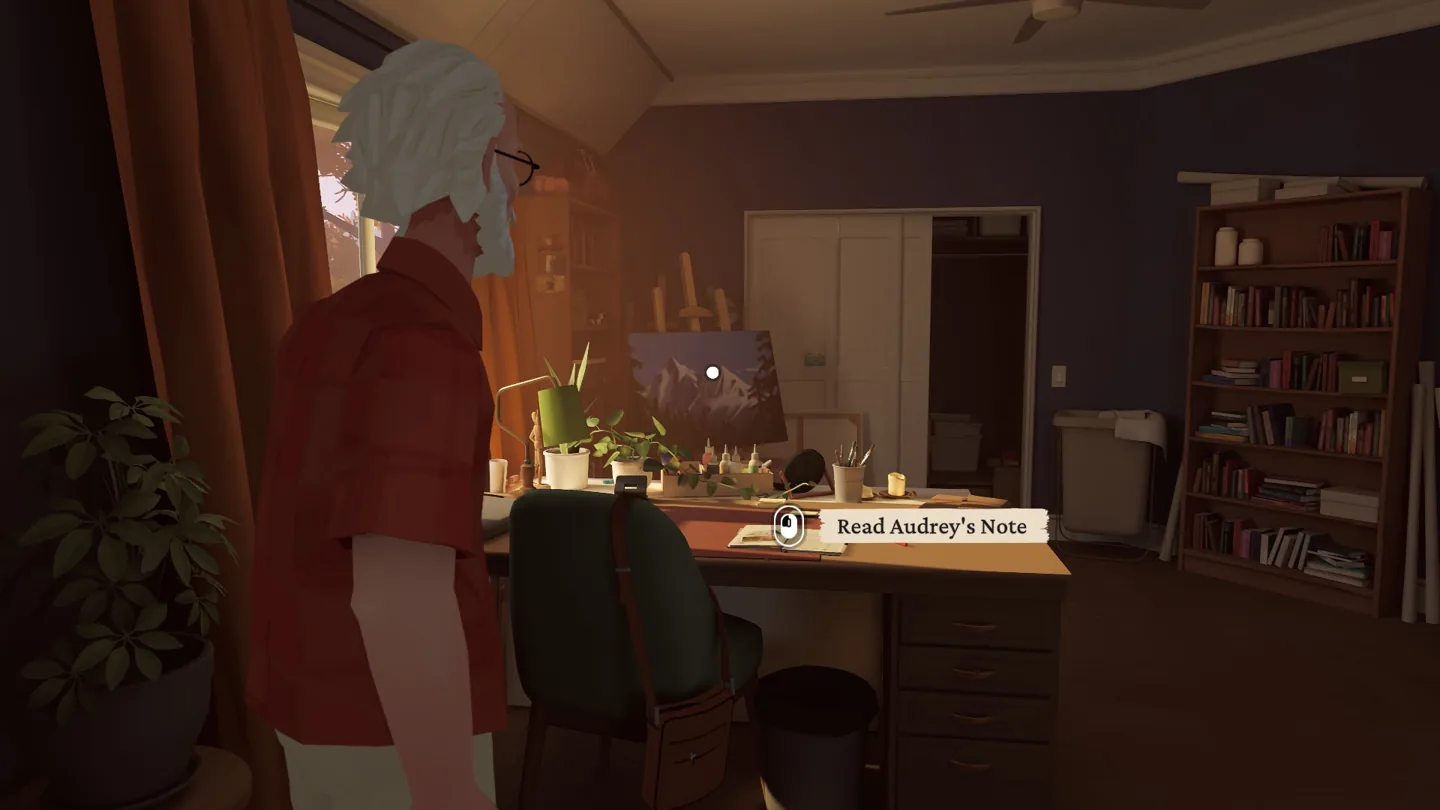
After the flashback, Alfred opens the drawer, goes through the journal, and reads Audrey's final note. This places the written record beside the memories the game has just revealed. The journal is no longer only a list that moves Alfred from one destination to the next; it is also an expression of Audrey's care for what happens to him after her death.
Her intention gives the tasks a meaning beyond obedience. Remembering a favourite place is valuable, but so is the act of going outside, speaking to another person, and allowing an unplanned encounter to matter. The journey creates opportunities for Alfred to do those things while following a route grounded in their relationship.
The note should not be treated as proof that every practical success on the trip was guaranteed. The route contains setbacks precisely because Alfred cannot control the world around him. Audrey's care remains meaningful even when an old business has changed or a plan breaks down.
Read the journal as an invitation to live with the memories rather than a mechanism for making the loss disappear. That interpretation connects the letter with both the earlier road-trip tasks and the later epilogue without needing an alternate outcome that the final scenes do not show.
The recurring idea is the limit of planning
The couple repeatedly return to the idea that life cannot be planned completely. That theme appears in affectionate situations as well as painful ones. A proposal can depart from its intended form, a destination can change, and illness can make the future different from what either person wanted.
Alfred's difficulty is not only that something terrible happened. It is also that he struggles with the distance between the life he tried to preserve and the life he now has. Revisiting a location cannot erase that distance, and completing a checklist cannot force the world to remain unchanged.
The story's practical interruptions make this theme visible during play. The road trip requires flexibility, help, and responses to events Alfred did not arrange. His progress depends on engaging with those events rather than controlling every part of the journey.
At the end, accepting that limitation does not mean the past was unimportant. The entire game demonstrates its importance through photographs, memories, and places. The more useful reading is that caring for those memories and responding to the present can happen together.
Other people help Alfred remain in the present
The journey introduces people with lives outside Alfred's relationship. Milton brings a different energy to a familiar shop. Sam offers help when the van and desert heat interrupt the trip. Near the coast, another traveller's relationship with an ageing dog gives companionship and mortality a different context.
These encounters matter because Alfred cannot fulfil the trip entirely through private recollection. He needs assistance and conversation. He also sees forms of care that are not copies of his own marriage, which broadens what connection can look like after Audrey's death.
The game does not need these characters to replace Audrey. Their role is to make the present less empty and to give Alfred chances to respond with something beyond irritation. Accepting help becomes part of continuing the journey rather than evidence that his original relationship matters less.
This also explains why the epilogue can remain quiet. The road trip has already shown a gradual change in how Alfred relates to what is around him. The final ordinary actions allow that change to appear in his life at home rather than requiring a new speech that explains it all again.
The dog makes the final hope concrete
The stray dog becomes an important companion during the trip. Alfred's relationship with it develops through travel and small shared actions. By the mountain sequence, finding the dog is a direct concern, and the reunion provides a tangible connection within an otherwise difficult part of the story.
In the epilogue, the dog is still part of Alfred's everyday life. After moving through the house and making dinner, he goes to play with his companion. The final emphasis is therefore on an activity he can participate in now, rather than only another image from the past.
That is a modest form of hope. The game does not show that one road trip permanently removes grief or that a pet repairs every consequence of bereavement. It shows Alfred attending to another living being and making room for an ordinary shared moment.
The distinction helps keep the ending grounded. Audrey's absence remains real, while the dog's presence gives Alfred a continuing responsibility and relationship. The final scene does not have to undo the loss in order to show that something valuable is still possible.

The photographs preserve change rather than reverse it
Photography initially helps establish the couple and later records Alfred's journey. Choosing pictures for the journal lets him keep people, places, and details from the present alongside the older associations that brought him there. The same object can therefore contain both remembrance and new experience.
That is why the album's meaning is larger than its selection limit. The story is not asking you to identify a single mathematically correct set of pictures. The practical choice creates a record of what the trip became, including things Alfred could not have planned before setting out.
A photograph also makes the difference between preserving a moment and possessing it visible. Alfred can keep an image of a place without returning that place to its earlier state. The ending carries that idea into his relationship with Audrey: memory remains available, but it cannot make the shared past happen again unchanged.
The epilogue extends the camera's theme through action rather than another destination. Alfred can live in the home associated with his memories, make a meal, and go outside with the dog. Those acts give the remembered life a continuing context instead of turning it into the only life he is allowed to have.
Read the final scenes without inventing another ending
The ending presents a sequence of memories, the final note, and an ordinary-life epilogue. Nothing in that sequence requires the claim that a particular optional photograph unlocks the hopeful interpretation or that the dog is secretly a replacement for Audrey. Those explanations add conditions the shown ending does not establish.
The supported emotional movement is from a man resisting change toward a man still grieving but participating in life. His return home does not make the road trip pointless. It brings the change into the place where continuing to live will actually happen, beyond the temporary structure of Audrey's itinerary.
The final domestic actions also keep the scale human. After the crash, the search, and the final memories, the story ends with food, familiar objects, and play. The relationship with Audrey remains part of Alfred's world, while his attention can also reach the companion waiting beside him.